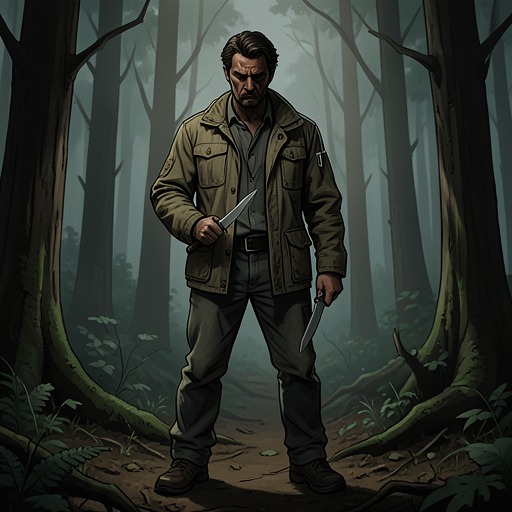
Cooper’s Massacre of the Invading Pack
How to Flirt with A Naked WerewolfCooper’s Massacre of the Invading Pack is the killing of twelve members of Jonas’s wolf pack by Cooper during an attack on his family’s valley. The confrontation saved Maggie Graham and defended the pack’s territory, but Cooper’s memory of the violence became a source of nightmares, guilt, and estrangement from his family.
Background and Precipitating Conflict
The attack unfolded against the responsibilities Cooper had assumed as alpha. The role meant more than leading the pack: the alpha made consequential decisions for the village and its families, while the pack drove away threats, from wild animals and criminals to other unwanted intruders. Cooper recalled that he had taken too much of that burden onto himself and had sent people he cared about into fights. He associated leadership not only with protection, but also with the harm he believed he had caused.
About a year after Cooper became alpha, an outside pack arrived at night and dragged his younger sister, Maggie Graham, from their home. Its alpha, Jonas, threatened to kill her unless Cooper surrendered control of the valley. The invaders had come from beyond Vancouver after exhausting their own hunting grounds, and had carefully scouted the valley: they knew the packlands’ vulnerabilities, the village’s layout, the number of able fighters, and what they saw as Cooper’s weakness as a leader. Surrounded by his family, Cooper could think only to offer the newcomers a place in the valley. Jonas refused, leaving Cooper to face the threat with Maggie in his enemy’s grip and his family looking to him for a response.
The Fight and Its Outcome
Maggie did not wait passively for Cooper to rescue her. She bit Jonas on the arm, kicked him, and insulted him, disrupting his hold long enough for the confrontation to turn violent. When Jonas went for her throat, Cooper changed before Maggie could; both packs then phased, and the fight became unavoidable. Cooper initially held Jonas off, but another wolf leapt onto his back. As Jonas forced Maggie to the ground with his teeth at her neck, Cooper’s attention fixed on the immediate danger to his sister. He killed the wolf attacking him, pulled Jonas away from Maggie, and ripped out Jonas’s throat.
Maggie killed one of the invaders. Cooper killed the rest, one by one, snapping at members of his own pack when they tried to intervene. When he changed back to human form, all twelve members of the invading pack were dead. The sequence moved from a threat against Maggie and the valley to a complete slaughter: Cooper’s actions ended the attack, but their scale became inseparable from his memory of the event.
Cooper did not understand the deaths as a clean victory. He regarded the wolves as people, not merely enemies in animal form, and was horrified that he had been capable of killing them all. His family and pack praised his defense of the valley and treated the outcome as proof of strong leadership; Cooper instead woke screaming from nightmares, could not bear to be around his family, and believed he did not deserve them. The conflict therefore left two opposed judgments in its wake: the pack saw a leader who had protected his home, while Cooper saw himself as someone who had crossed a moral boundary from which he could not return.
The Memory’s Moral Weight
Cooper’s recollection began not with the killing but with his failure to act: when Jonas threatened Maggie, Cooper froze. He remembered her looking to him as her big brother, confident he would protect her, and the instant she realized he did not know what to do. That image remained a source of nightmares. Maggie’s defiance—biting Jonas and kicking him—sharpened the contrast between her immediate courage and Cooper’s paralysis before he changed and intervened.
The violence itself remained unusually clear in Cooper’s memory as a wolf. He recalled killing the attacker on his back, pulling Jonas away from Maggie, and then killing the rest of the invading pack one by one. Members of his own pack tried to help, but he snapped at them; when he returned to human form, all twelve invaders were dead. The clarity of the memory made it difficult for him to treat the deaths as an indistinct consequence of battle. He understood the wolves as people, and feared what his own capacity to kill said about him.
Cooper later disclosed the episode to Mo during an intimate conversation. He described the nightmares, his inability to resume life with his family, and his belief that he did not deserve them. He also believed Maggie had been able to forgive his hesitation and the killings, but not his inability afterward to return to being her carefree older brother; in his view, his departure gave her a reason to resent him for abandoning the pack and refusing the role she seemed better suited to hold. Mo did not dismiss what he had done, but placed it alongside his effort to protect his family, telling him she could not condemn him for acting as she believed he had acted to protect her. Her response brought visible relief: Cooper asked whether she was angry, then leaned into her as the tension left his body.
Later Reassessment
Much later, after further violence had tested Cooper’s resolve, Mo found him staring at the ground and told him there would be no regrets and no more tormenting himself with guilt. Cooper agreed. The exchange marks a change from the man who had understood the deaths of Jonas’s pack as proof that he was undeserving of his family: he could acknowledge what he had done without continuing to condemn himself for it. He wrapped his arms around Mo and said he supposed he would have to marry her, turning the admission of guilt into a moment of intimacy and a commitment to their future.